
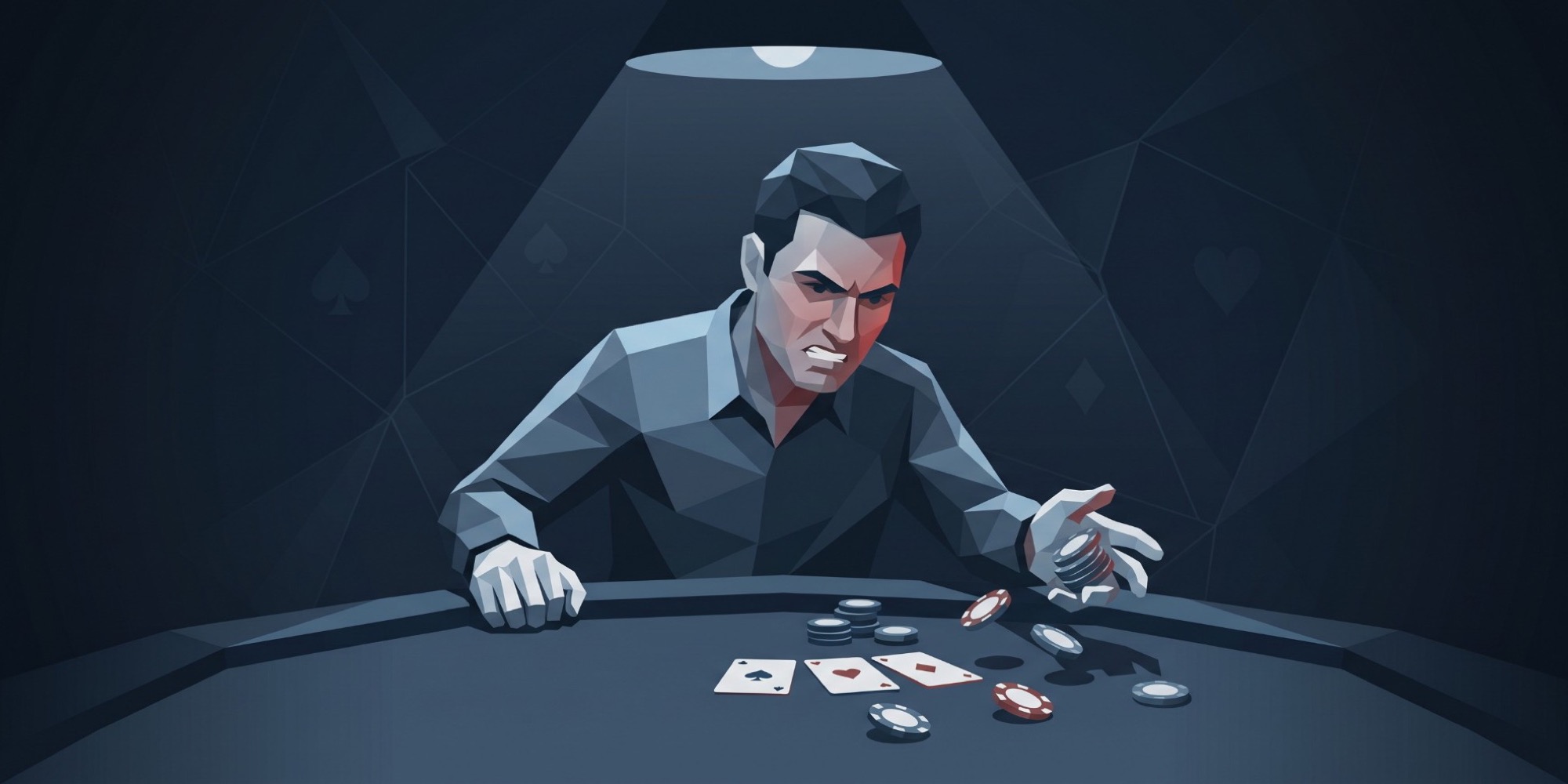
Tilt is when frustration or anger, usually after losses, pushes your decisions away from your normal game. It doesn't always feel like anger: it can feel flat and irritated. It usually builds over several hands, which is why you rarely notice it starting, and being tired or drinking makes it worse. Once it's strong, it's hard to manage, so most of the work happens earlier: how you prepare, what you're playing for and the small resets you use while setbacks are still small.
It's hour nine of a series day. You're 20 left in a tournament that matters, you get it in with AK against 77 for a big stack, and the board runs out low. You survive with eight big blinds and bust a few orbits later.
Over the next hour, nothing dramatic happens. You don't shout or slam the desk. But you open a few hands from early position that you'd normally fold. You call a 3-bet you'd usually fold to. You register a tournament that wasn't in your schedule, because you're here anyway.
If someone asked how you felt, you'd say fine. A bit flat, maybe. Wanting something to happen. That's tilt too. It's harder to spot than the angry version, and it can cost just as much.
(This is a composite example, not one specific player.)
What is tilt in poker?
Tilt is a loss of control over your decisions driven by unpleasant emotions, usually frustration or anger after a loss. It doesn't always feel like anger. It can feel like irritation, a flat mood or a strong need to win something back. I measure it against your own A-game, not a perfect player: tilt is when those feelings push your decisions away from your own standard. That makes it something you can notice and work on.
The questionnaire researchers use to measure tilt asks about three kinds of signs:
- Emotional: irritation, frustration, feeling that it's unfair, sadness.
- Behavioral: clicking faster, hitting the keyboard harder, playing without thinking about the consequences.
- Cognitive: paying less attention, taking more risks, feeling like you've lost control of the game.
When researchers asked 60 online players to write about their worst losses, many of the stories followed a similar path. First came disbelief. Then a strong sense that what happened was unfair. Then the urge to win the money back, right away.
Tilt isn't only a poker thing. The word comes from pinball, and the same pattern shows up in chess, esports, trading and sports like golf and tennis: a setback, a reaction that builds, and decisions that get worse. Even top chess players, in a game with no luck at all, play less accurately after small mistakes. That's useful for poker players, because what works in those fields can work at the table too.
Other states players call tilt
Players use the word for more than frustration. You'll also hear "tilt" for impatience, for loose play after a good run, or for playing scared. The research on tilt mostly studies one thing: what happens after losses, when frustration or anger takes over. These other states also move decisions away from your normal game, but they work through different routes, so they need different fixes.
Impatience. Nothing is going wrong, but nothing is happening either, and you start forcing spots to make something happen.
Winner's tilt. After a good run, your ranges get wider and your risk feels smaller than it is. What you expect from the session moves up without you noticing.
Playing scared. You fold +EV spots because of what losing would mean: the stack, the payout jump, the week's results.
This article is about the first kind: frustration and anger, how they build and what to do about them.
How tilt builds up during a session
An emotion is a fast, automatic process. Something happens. Your attention goes to one part of it on its own. Your mind evaluates what it means, and your body and mind react. Most of this happens before you're aware of it, and sometimes you don't notice it at all.
Take the lost flip. Your attention jumps to your stack and to the pay jump you just missed. Your mind reads it as "I always lose these". Your body heats up, you click faster and you open a little wider, often without noticing any of it.
The key point is that this reaction becomes part of the next hand. You start it with a shorter stack and a body that's already tense, so the next small setback lands on top of the last one. It builds hand by hand, which is why the first few minutes after a bad beat are the easiest time to manage it.
A single reaction usually passes quickly. A few in a row can turn into a mood: something that lasts longer, has no clear cause and colors every decision. That's what happened to the player in the opening example. The lost flip started it, but an hour later it didn't feel connected to that hand anymore, so there was nothing obvious to notice.
Replaying the last hand in your head while you play the next one keeps it going. It also takes attention away from the decision in front of you.
What makes it hit harder
Not every bad beat hits with the same force. Several things change that:
- How much the spot matters: a big pot, a bubble, a final table, a series goal you've been chasing all month.
- What you're playing for and what you expected: more on this below.
- How much was in your control: a cooler and a punt feel different, and they should.
- Your state: one study followed 23 regular online players for four weeks. Sessions that ended after 16 or more hours awake showed more tilt, more hands played and worse results than the same players' rested sessions. Drinking alcohol was also linked to more tilt.
- Your temperament: some players react strongly and often, others rarely do. The first group needs more structure around the session.
What you're playing for, and what you expect
Your goals for the session change how much each setback weighs. If the only goal is to win, every lost flip and every cooler hits that goal directly, and a run of bad luck becomes a run of direct hits. When part of the goal is how you play, like following your rules or taking your time in big spots, a bad run still hurts, but it doesn't ruin the whole session.
What you expect from the session matters too. If you sit down expecting to win and you're losing, that gap is there in every hand, and each setback adds to it. A loss you were ready for usually weighs less than one that breaks a plan you'd already made in your head. Results in a single session say little about how you played, so an expectation built on them is easy to break.
Why it's hard to notice your own tilt
Tilt rarely announces itself. Each decision feels close enough to the last one, and the mood that's shaping your play is also shaping how you judge it. "That call was fine" sounds the same whether it's true or not.
In a study of 291 online players, how often players thought they tilted only partly matched what they reported when asked about specific things, like clicking faster or playing without thinking about the consequences.
So a general sense of "I'm fine" isn't enough. Concrete signs are easier to trust: what you're doing at the table, and what's changing in your body.
What emotional regulation is, and why it matters
Emotional regulation is what you do, on purpose or out of habit, to change how strong a feeling gets, how long it lasts and how much it shows up in your decisions.
You can't control emotions. The process starts on its own, often before you're aware of it, so you can't decide not to feel frustrated after a cooler. What you can do is regulate them: bring the intensity down, give them less time and keep them out of your next decisions.
This matters a lot in poker. The game gives you a steady supply of moments that trigger strong emotions: coolers, downswings, big pots, bubbles, long days. How well you regulate is a big part of the distance between your best game and your average one.
Emotional regulation is also a skill, and it's separate from temperament. A calm player can struggle with it, and a player who reacts strongly can be very good at it. Like any skill, it improves with practice: noticing earlier, choosing a better response and checking afterwards whether it worked. The more you practice it, the more confident you tend to feel walking into hard situations, because you've handled them before.
If you want to build this around your own schedule and your own tilt patterns, this is the kind of work I do in 1:1 sessions.
How to manage tilt: before, during and after a session
Managing tilt once it's strong is very hard. By the time you notice it, it has probably been shaping your decisions for longer than you think, and a strong reaction leaves little room to think your way out.
So not tilting depends less on what you do in the worst moment and more on your process: how you build your sessions so you can regulate as setbacks happen, while they're still small. That means your state when you sit down, what you're playing for, the rules you set in advance and the short resets you use along the way.
What follows is based on research on emotions and on what that research shows tends to help. It's also what I use with players.
If you're already tilting
Use this to limit the damage.
- Check your signs. What are you doing differently, and what's changing in your body?
- Name the feeling. Frustrated, under pressure, drained? The word tells you what you need.
- Reset. Step away from the action for a hand or an orbit, or take a full minute between decisions. Breathe slowly and put your attention back on the next decision.
- Check again. If the signs are still there, follow the rule you set before the session.
The rest of this section is about the process that keeps you from getting there: why these steps work and how to prepare them, before, during and after the session.
Why "just stay calm" doesn't work mid-session
When a reaction is strong, trying to think your way out of it rarely works. Rethinking what happened takes mental effort: you have to hold the situation in mind and work on it, and that uses the same limited capacity you need for the hand in front of you. With a strong reaction and several tables open, there isn't much left. That's why the reset is a short break and not a conversation with yourself. Putting the hand in perspective belongs before and after the session, when you have time.
A poker face doesn't calm you down either. Hiding a reaction keeps opponents from reading it, which has real value live, but the reaction is still there, and holding it in takes energy.
And fighting the feeling makes it worse. Frustration after a bad beat makes sense: something you wanted just slipped away. Being frustrated that you're frustrated adds a second layer on top.
Give the feeling a name
Feelings at the table aren't good or bad. They tell you something. Frustration after a lost flip means something you wanted just got blocked. Excitement after a big pot means your expectations went up. Neither feeling has to go away. What you want to watch is what it does to your next decisions.
Putting a precise word on it helps. Research on emotions finds that naming a feeling tends to take some of its force away, and that people who can tell similar feelings apart tend to handle them better.
The word also tells you what you need. "Frustrated", "under pressure" and "drained" can all feel like "I'm not playing well", but each one asks for a different move. You'll find them in the "during the session" steps below.
Before you sit down: check your state and set your rules
Check your state. How long have you been awake? How did you sleep? Have you been drinking? Is something outside poker weighing on you? Your answers should change the session: fewer tables, a shorter schedule, a later start, or no session at all. The 16-hour finding from the sleep study is a reasonable line to watch. Run this check again every time you're about to add something: a new tournament, a late reg, a new table. Those are the moments when your state still decides how much you'll play.
Decide what you're playing for. Before you start, write one or two things you'll judge the session on that are in your control: following your rules, taking your time in big spots, sticking to your schedule. Then check what you're expecting. If you notice you're counting on a win today, it's better to see that before the first hand than after the third cooler.
Decide your rules while you're calm. People who handle impulses well tend to fight them less in the moment. They decide ahead of time, with plans and habits, so there's less to fight. For tilt, that means rules written before the session:
- If I lose X buy-ins today, I stop adding: no new registrations, no new tables.
- If I notice two of my markers, I run my reset.
- If the markers are still there after the reset, I add nothing new and play only what's already running, or I leave the table.
Write these rules down. You judge the session by whether you followed them, not by the result.
Write down your markers. List the concrete signs that show up when you start to drift: behaviors, and changes in your body or energy. For example:
- Registering tournaments that aren't in the schedule.
- Changing your open sizes or 3-bet sizes.
- Opening the lobby, the cashier or your results mid-session.
- Snap-calling spots you'd normally think about.
- Typing in the chat.
- Adding tables.
- Heat in your face, a tight jaw or faster breathing.
- Feeling suddenly drained, or restless.
Your list will be different. Build it from your own history.
Prepare two or three lines in advance. Rethinking a bad beat is hard to do on the spot. It's much easier when you already have the words. People rethink a situation more often when they have concrete options ready. Write one line for each of your most common spots: the cooler, the lost flip, the bubble exit. Keep them short and true. Add them to your checklist.
During the session: use your checklist
Check your markers, then name what you feel. Check them at set moments, like every break, and right after any big hit: a cooler, a lost flip, a bust. Those first minutes are when a reaction is easiest to manage. When a marker shows up, find the word for what you're feeling.
Match the move to the word. Frustrated or angry: use your reset. Under pressure in a big spot: slow down, use your time on purpose and put all your attention on the one decision in front of you. Drained: play less, with fewer tables, no new registrations or leaving the table.
Use a short, cheap reset when a reaction is strong. Sit out one hand or one orbit. In tournaments, sitting out costs blinds, so keep it short, or take your minute between decisions instead. Breathe slowly for a minute. Then put your attention on neutral parts of the task: stack sizes, positions, the next decision. You're giving the reaction nothing new to build on for a moment.
Talk to yourself from a little distance. Use your name or "you" instead of "I". Or ask how this hand will look in your review on Tuesday. Studies on this kind of distance find it reduces emotional reactions.
Keep, change or stop. After the reset, check your markers again. If they've settled, keep playing. If they haven't, apply the rule you wrote before the session. You made that decision earlier, when you were calm, so now you only have to follow it. Stopping can look different depending on what you play: no more registrations and careful play in what's already running, or standing up from the table.
Online and live. Online, decisions come fast, so keep the reset short and cut tables if you need room. Live, you have more time between hands. Use it for the slow breath and the prepared line, and don't check your results on your phone.
After the session: the review
Keep the review concrete. Ask "How did this happen?" and "What do I do differently next time?" Avoid "Why does this always happen to me?" Research on repetitive thinking finds that the concrete style helps people recover and solve problems, while the abstract "why me" style keeps the unpleasant feeling going.
Separate what you controlled from what you didn't. For variance, the cooler and the flip, rethinking is the right tool. For what you could control, like the hands you forced, the break you skipped or the session you started tired, the useful move is to change something. Feeling better about a mistake you can fix can take away the reason to fix it.
Close the session before you go to bed. Finish with the short review, not with the lobby or a results tracker. Sleep and how you handle emotions affect each other, so a calmer end to the night helps both.
Review the feeling the way you review a hand. With curiosity, not judgment: what did I feel, when did it start, what did I do with it, and did it work? If the move didn't work, try a different one next time.
Update your checklist. Each tilt episode shows you where your plan broke. Maybe there's a new marker, or a rule that needs to start earlier. Write it down while it's fresh.
When tilt is more than a performance issue
Every player has hard sessions. But some patterns go beyond performance:
- Playing over your bankroll or your plan again and again.
- Hiding how much you play or how much you've lost.
- Playing to escape how you feel.
- Weeks of low mood, or sleep problems that don't improve.
In a study of online players, those who reported tilting more often also scored higher on measures of problem gambling. That's an association, not a cause, but it's a reason to take a frequent pattern seriously.
If any of this sounds familiar, talk to a mental health professional or a gambling support service. My work is performance coaching, not clinical treatment. When something needs clinical care, I refer players to people who do that work.
Your next step
If you want to build this with someone who works only with poker players, book a 30-minute diagnostic call. If you'd rather look at the options first, see all services.
FAQ
You can't switch tilt off, but you can catch it early and limit what it costs you. Before the session, check your state and write a stop rule. During it, check your markers after every big hit and take a short reset. Afterwards, review how it happened and update your plan.
Tilt in poker usually starts with a setback, like a cooler, a lost flip or a bust near the money, and builds as the next hands go wrong. How hard it hits depends on several things at once: how much the spot matters, what you expected, how much was in your control, how tired you are and your temperament.
The most reliable way to know if you're tilting is to check concrete signs, because tilt also affects how you judge your own play. Common signs are opening hands you'd normally fold, changing your sizings, adding tables, registering outside your schedule, checking results mid-session, and a tight jaw or faster breathing. Write your own list and check it at every break.
Research on tilt mostly studies frustration or anger after losses, and it doesn't always feel like anger: it can be irritation, a flat mood or the urge to win the money back. Players also use "tilt" for impatience (forcing spots), winner's tilt (playing looser after a good run) and playing scared (folding good spots because of what losing would mean). Each one needs a different fix.
Whether to stop depends on the format. In cash games, leaving the table is a real option if a short reset doesn't help. In tournaments you usually can't leave what's already running without giving up equity, so the key decisions come earlier: check how you slept and how you feel before you start, don't start if you're not ready, and once you're playing, stop registering new tournaments.
Yes, sleep seems to affect tilt. In a four-week study of 23 regular online players, sessions that ended after 16 or more hours awake showed more tilt, more hands played and worse results than the same players' rested sessions. Alcohol was also linked to more tilt. If you're short on sleep, play fewer tables or a shorter session.
Tilting by itself isn't a sign of a gambling problem, and most players tilt sometimes. But in one study of online players, those who tilted more often also scored higher on measures of problem gambling, although that doesn't show one causes the other. If you keep playing over your bankroll, hide your losses or play to escape how you feel, talk to a mental health professional or a gambling support service.
- Adhikari, A., Anatolyev, S., & Dagaev, D. (2024). Do mistakes provoke new mistakes? Evidence from chess. IEEE Transactions on Games, 16. https://doi.org/10.1109/TG.2023.3275710
- Bonilla, I., et al. (2024). Conceptualization and validation of the TILT questionnaire: Relationship with IGD and life satisfaction. Frontiers in Psychology, 15, 1409368. https://doi.org/10.3389/fpsyg.2024.1409368
- Brackett, M. (2019). Permission to feel. Celadon Books.
- Coval, J. D., & Shumway, T. (2005). Do behavioral biases affect prices? Journal of Finance, 60(1), 1–34. https://doi.org/10.1111/j.1540-6261.2005.00723.x
- Gross, J. J., & Ford, B. Q. (Eds.). (2024). Handbook of emotion regulation (3rd ed.). Guilford Press.
- Hamel, A., Bastien, C., Jacques, C., Moreau, A., & Giroux, I. (2021). Sleep or play online poker? Gambling behaviors and tilt symptoms while sleep deprived. Frontiers in Psychiatry, 11, 600092. https://doi.org/10.3389/fpsyt.2020.600092
- Moreau, A., Chauchard, É., Sévigny, S., & Giroux, I. (2020). Tilt in online poker: Loss of control and gambling disorder. International Journal of Environmental Research and Public Health, 17(14), 5013. https://doi.org/10.3390/ijerph17145013
- Moreau, A., Sévigny, S., Giroux, I., & Chauchard, E. (2020). Ability to discriminate online poker tilt episodes: A new way to prevent excessive gambling? Journal of Gambling Studies, 36(2), 699–711. https://doi.org/10.1007/s10899-019-09903-7
- Palomäki, J., Laakasuo, M., & Salmela, M. (2013). 'This is just so unfair!': A qualitative analysis of loss-induced emotions and tilting in on-line poker. International Gambling Studies, 13(2), 255–270. https://doi.org/10.1080/14459795.2013.780631

Alan Longo is a performance coach and psychologist by training (UADE, licensed). He has spent more than six years working only with poker players, on the structure and routines that keep their decision-making consistent.
More about Alan →