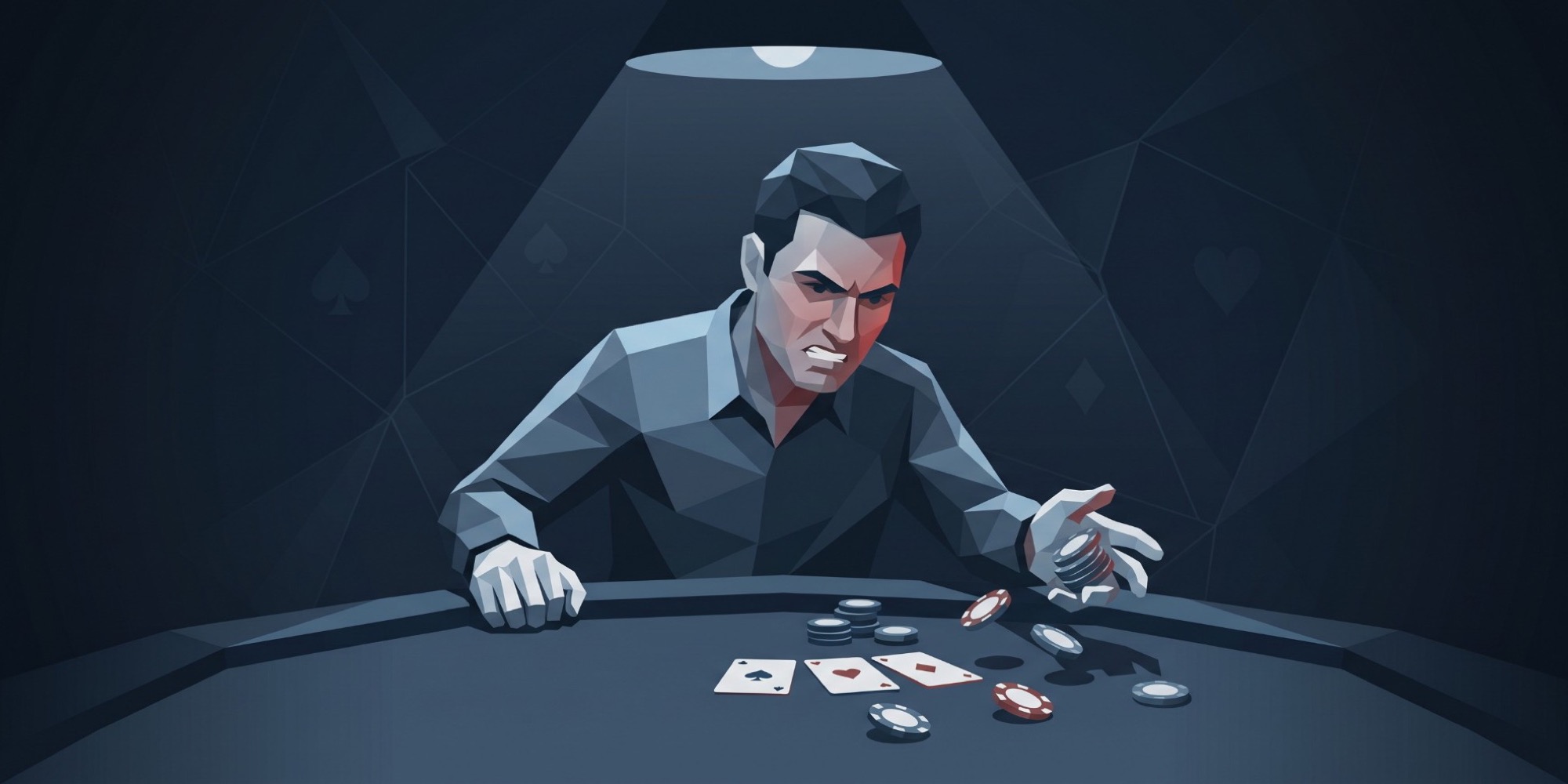
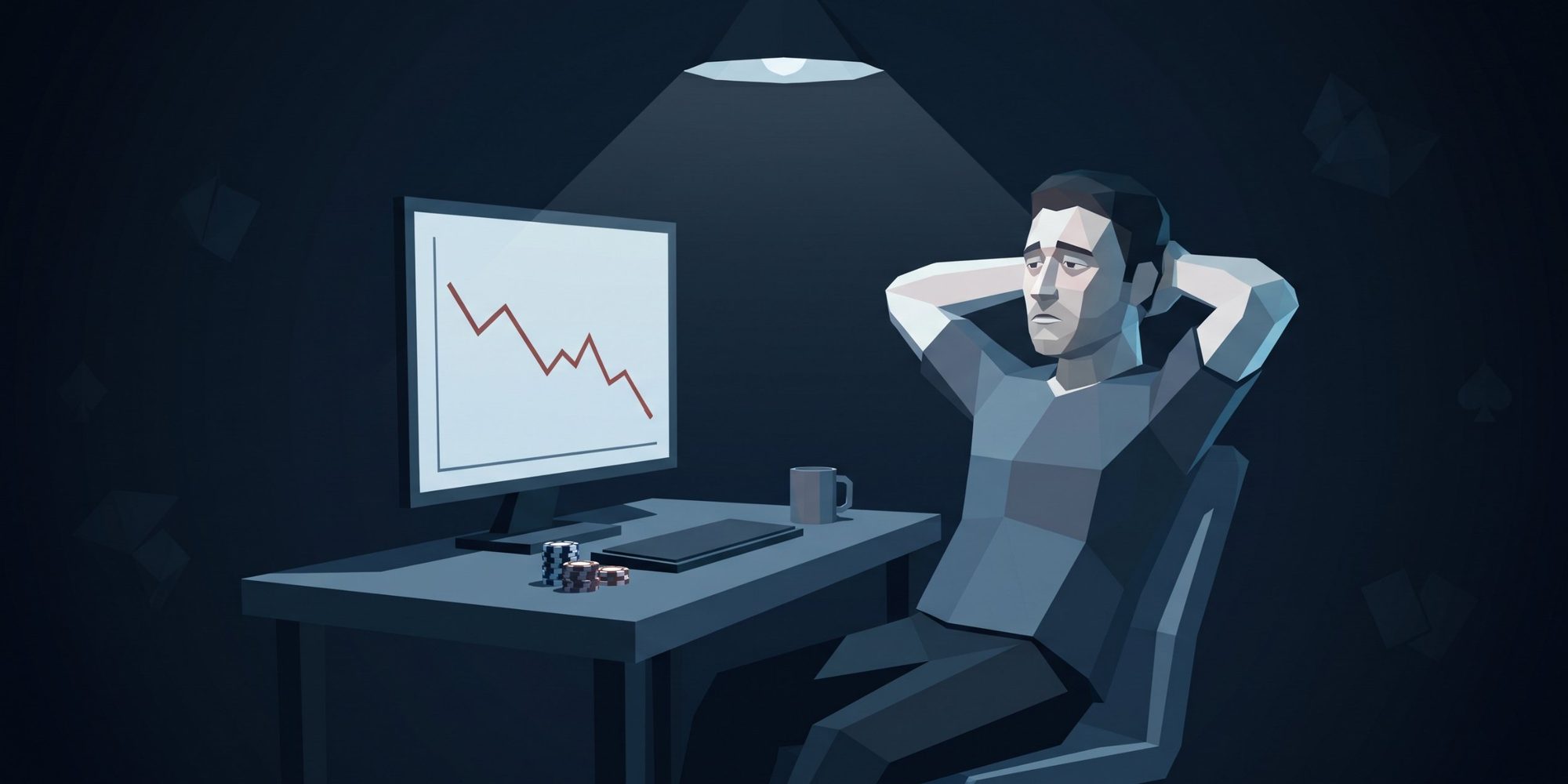
A downswing is a stretch where your results stay below what your game should produce. You can't avoid them: a winning player can go several months without a profit. What you can work on is how much damage a downswing does to your confidence, your decisions and your finances. The first step is to work out which of the three types you're in, because each one needs a different response.
The player has been winning for two months. Not by a lot, but steadily, and his review notes show solid decisions. Still, every session starts with the same line: "I'm in a brutal downswing."
What hasn't moved much is the makeup. It got deep during a bad stretch earlier in the year, and until it's cleared, there's no chop. So every session feels like part of the same downswing. He registers tournaments that weren't in his schedule "to get it back." He's short with the people around him. He's tired of poker, and he hasn't had a losing month since summer.
His results turned weeks ago. The downswing he's still going through is somewhere else.
(This is a composite example, not one specific player.)
What is a downswing in poker?
A downswing is a period where your results run consistently below what you'd expect from how you play. It's a trend, and it's measured over weeks or months, not over one bad session.
Downswings are a normal part of poker. A winning player can go several months without making money, especially in big-field tournaments or live, where the swings are bigger. That's a fact of the game, and it says little about your level on its own.
Can you avoid a downswing?
No. If you play enough volume, you'll go through downswings, including long ones, even when you're doing everything right.
What you can change is what happens while you're in one: how much it costs you, and how likely it is to drag on. Some players come out of a downswing playing better than they went in. Others come out with a smaller bankroll, a damaged game and less desire to play. The difference usually comes down to what they did while it was happening.
What can a downswing cost you?
The obvious cost is money. But a downswing that goes on for a while can cost you in three places at once.
Money. Your bankroll shrinks, or your makeup grows. Either way, the pressure to win it back goes up, and if poker pays your bills, that pressure follows you home.
Your head. Confidence drops, your mood gets worse and motivation fades. For some players this stays small. For others it becomes the hardest part, and it shows up outside poker too.
Your game. Under that pressure, it gets easier to make decisions you wouldn't normally make: playing too much, playing too high, or changing a strategy that was working.
Without a plan, these costs tend to grow the longer the downswing lasts, and they feed each other. Money pressure makes the mental side heavier, and a heavier head leads to worse decisions.
With a plan and some structure, the same downswing usually costs less. Playing lower stakes or fewer tables makes each swing smaller in money terms, which takes some of the financial pressure off. A bigger edge makes it more likely that your results turn sooner. And keeping your study and your routines in place protects your decisions and your confidence while the results catch up.
The goal is to keep the next downswing from costing you more than it has to.
Are you in a downswing or just in a hole?
A downswing is a trend in your results. Makeup and a short bankroll are a balance. They usually start together, but they don't end together.
I often work with players who say they're in a downswing months after their results turned. When we look at the last two or three months, they're winning. What hasn't changed is the hole: the makeup is still deep, or the bankroll is still below where it was. So it still feels like a downswing.
Makeup makes this harder in a specific way. In many staking deals, you don't get a chop until the makeup is cleared. Every deal is different, but that's a common setup. So while the makeup is big, you can play well for weeks and see no money of your own. The makeup stops being a number in a spreadsheet and becomes the hole you have to get out of before anything counts. That's frustrating, and the bigger it gets, the heavier it feels.
Some backers soften this with a pre-chop or a monthly salary. It helps you pay your bills, and depending on the deal, that money may also go into the makeup.
That's why it helps to look at the trend and the balance separately:
| What you see | What it is | What to look at |
|---|---|---|
| Results below expectation over recent weeks or months | A downswing (a trend) | Your decisions, and how big your recent sample really is |
| Recent results positive, makeup still big | Makeup (a balance) | The trend has ended. The deal, not your game, sets how long it takes to clear |
| Recent results positive, bankroll still below its peak | Rebuilding (a balance) | Whether your stakes still fit the bankroll you have now |
What are the three types of downswing?
When I work with a player in a downswing, the first thing we do is separate it into three types. The better you understand which one you're in, the easier it is to choose what to do, because each one needs a different plan.
The results downswing. This is the classic one. You're losing, consistently, over a meaningful stretch. You might be playing well or badly. What defines it is the results.
The performance downswing. Here your decisions are getting worse, consistently, across several sessions. You can see it in your stats and in your hand reviews. You might be winning or losing at the same time. This one is technical, so the best person to help you see it is usually your strategy coach or study group.
The mental downswing. Here the signs are emotional: less motivation, less confidence, irritability, tilt, negative self-talk, a strong focus on results, boredom, not wanting to play. You might have one of these or several. This is the only type that follows you away from the tables. It shows up in your sleep, your mood and your personal life too. Financial pressure can make it worse, because it pushes you to play from need. If tilt is a big part of it, start with Poker tilt: what the research says and what actually helps.
The three are connected. A downswing usually starts with results. Long enough, and it starts to affect how you feel about your game. In large reviews of studies that followed the same people over time, recent results shaped confidence much more than confidence shaped the next results. So your confidence can drop even when your skill hasn't changed.
From there, it can go either way. The mental side can reach your decisions: you force spots, you play outside your plan, you stop studying. And a drop in your decisions produces worse results, which feeds the rest. The order isn't fixed, but the point is the same: the results downswing is the one you can't control, and the other two are the ones you can.
Am I running bad or am I actually bad?
You can't answer this question from your results. Over a few weeks, or even a few months, your results are mostly noise. They don't tell you clearly how well you played.
The problem is that people judge decisions by their results anyway. It's one of the most replicated findings in decision research. In a 2023 replication with almost 700 people, participants rated the same decision as worse when it ended badly, and they did it even when they said results shouldn't matter. Knowing about the bias doesn't remove it.
Professionals aren't immune. NBA coaches changed their starting lineup more often after narrow losses than after narrow wins, in games where the result said very little about the plan. In football, players whose shot hit the post and went in got better ratings and more playing time than players whose shot hit the post and went out, even though the shot was the same.
In poker, this is how a results downswing turns into a performance downswing. You change a strategy that was working because the results told you to, and the results were mostly cards.
It works in the other direction too. "It's just variance" can be true, and it can also hide a real leak. When feedback is mostly noise, experience alone doesn't correct your mistakes, and the feeling that you're playing well isn't a reliable signal either.
So the answer has to come from your decisions. Review your hands, not only the big losing ones, and look at your stats with someone who knows your game technically.
Why does it feel like you lose every flip?
Most players in a downswing say some version of "I lose every all-in." It's impossible to lose every all-in. It's a generalization, and it usually comes from a few things working at the same time.
When you ask yourself how often you lose flips, you don't count. You remember. And the hands that come to mind first are the expensive ones: the cooler on the bubble, the river at the final table. The flip you won on a quiet Tuesday doesn't come to mind.
Once the idea is there, it starts to collect evidence. Each lost all-in confirms it. Each won all-in feels like an exception, or you don't notice it at all.
There's also something about how people read streaks. Research on random sequences finds that people expect a coin or a roulette wheel to even out, but expect their own streaks to continue. Poker sits in between. The cards are random, but a downswing feels personal, and that may be part of why "I'm due" can turn into "I always lose."
What I do with players here is simple. Write down every all-in you play and whether you won or lost it. Then review each one: mark the hand, look at it again and decide whether you played it well or whether there was something in your control you could have done better. The count brings the feeling back to the facts. The review turns the all-in into feedback you can use.
What changes in how you play and study?
When the losses keep coming, players react in different ways. These are the patterns I see most often.
Playing more to get it back. More days, more tables, higher stakes, all with the idea of winning back what you lost. It comes in different sizes, from one extra session a week to playing well above your usual stakes. Decision research has a name for this: the 'break-even effect'. When people are behind, an option that offers a way back to even feels more attractive than it really is. It shows up in professionals too. Traders at the Chicago Board of Trade took more risk in the afternoon after losing money in the morning, and game show contestants playing for large sums changed their choices depending on how the game had gone so far. It doesn't happen to everyone or every time, but it's a known pattern, not a beginner's problem.
Playing and studying less. The opposite reaction. Motivation drops, so volume drops, study drops and you look for other things to do.
Same volume, poor study. You keep playing because poker is your job, or because your deal asks for a certain volume. But without a clear study structure, the study loses quality. It turns into looking at the hands that hurt, or watching content with no plan.
The first two reactions point to the same thing: there isn't enough structure, so the response comes from emotion.
Players who have that structure tend to respond with more intention. Many of the players I've worked with have a downswing plan, set up in advance, and they start it when they see the losses are starting to affect them. They study more, play less volume, and often drop stakes or play fewer tables. Each player sets it up differently, but the idea is the same. At lower stakes your edge is usually bigger, so your results are more likely to turn and each swing costs less money. In parallel, the extra study improves their game, so they often come out of the downswing playing better than before.
Not every player needs to drop stakes. Some live players who are used to long swings can keep playing their usual games without it affecting them much, because they've been through it many times and they've worked on it.
What changes for all of them is the goal. During a downswing, the goal stops being to win the money back. It becomes keeping your level of play and rebuilding your confidence.
Which downswing are you in?
Before you change anything, work out which downswing you're dealing with. It's often more than one.
Take 20 minutes away from the tables, with your database open, and answer these questions in writing. The writing matters. In a large review of 138 experiments, people who tracked their progress reached their goals more often, and the effect was bigger when they wrote it down.
Results downswing
- Have your results been below expectation for weeks or months, and not just in the last few sessions?
- Is your sample big enough to tell you anything yet? If you play cash, how do your all-in adjusted results compare with your actual results?
- Are you playing the games, stakes and volume you planned to play?
If your decisions hold up and the gap is mostly in the cards, this is a results downswing. The work here is to protect the other two.
Performance downswing
- Looking at your stats and your hand reviews with your strategy coach or study group, are your decisions worse than usual across several sessions?
- Have you changed your strategy since the downswing started? Did that change come from study, or from results?
- Has your study dropped, in volume or in quality?
If the answer is yes, the problem is now in your decisions. That's harder to hear, but it's also the part you can work on most directly.
Mental downswing
- Do you notice less motivation, less confidence, more irritability or more tilt than usual?
- Is your self-talk more negative, or are you thinking about results much more than about decisions?
- Is it showing up outside the tables: in your sleep, your mood, your relationships?
- Are you feeling financial pressure, or playing because you need the money?
If the answer is yes, the downswing is now affecting how you see the game, and that often reaches your decisions next.
What to do with your answers. Write your conclusion in one sentence: "Right now my downswing is mostly ___." Then decide what you'll measure yourself on for the next month and add it to your plan. Pick things you control, like study hours, review quality and sticking to your stop rules, not results.
When a downswing is more than a performance issue
Every player has hard months. Playing a lot isn't the same as having a problem. But some signs go beyond performance:
- Trying to win back losses again and again, by playing over your bankroll or your plan.
- Hiding how much you play or how much you've lost.
- Playing to escape how you feel.
- Low mood or loss of interest most days for two weeks or more, or sleep problems that don't improve.
- Feeling exhausted and distant from the game for a long time, even after breaks.
If any of this sounds familiar, talk to a doctor or a licensed mental health professional where you live, or to a gambling support service. Find A Helpline lists free, confidential services in many countries, and Gambling Therapy offers free support online. My work is performance coaching, not clinical treatment. When something needs clinical care, I refer players to people who do that work.
Your next step
If you want to work out which downswing you're in and build a downswing plan for it, book a free 30-minute diagnostic call.
FAQ
It can last several months, even for a winning player. It tends to be longer in big-field tournaments and live, where the swings are bigger. You can't control how long it lasts, but you can control how much damage it does, and a bigger edge at lower stakes makes it more likely your results turn sooner.
Probably not anymore. A downswing is a trend in your results, and makeup is a balance. If your recent results are positive, the trend may have ended even though the makeup is still there. Seeing the difference changes what you need to work on.
Not from your results. Over weeks or months, results are mostly noise. Look at your decisions instead: review a random set of hands, not only the big losing ones, and check your stats with your strategy coach or study group.
Often it helps. At lower stakes your edge is usually bigger, so your results are more likely to turn and each swing costs less. Many players combine it with more study and fewer tables. Not everyone needs it, though. Some players who are used to long swings can hold their usual stakes without it affecting them.
Because you remember the expensive ones and forget the rest. Once the idea "I always lose" is there, each lost all-in confirms it and each win feels like an exception. Writing down every all-in and reviewing each one brings it back to the facts.
First work out which type you're in: results, performance or mental. Each one needs a different response. Then change the goal from winning the money back to keeping your level of play and rebuilding your confidence.
- Aiyer, S., Kam, H. C., Ng, K. Y., Young, N. A., Shi, J., & Feldman, G. (2023). Outcomes affect evaluations of decision quality: Replication and extensions of Baron and Hershey's (1988) outcome bias Experiment 1. International Review of Social Psychology, 36, 12. https://doi.org/10.5334/irsp.751
- Baron, J., & Hershey, J. C. (1988). Outcome bias in decision evaluation. Journal of Personality and Social Psychology, 54(4), 569–579. https://doi.org/10.1037/0022-3514.54.4.569
- Coval, J. D., & Shumway, T. (2005). Do behavioral biases affect prices? Journal of Finance, 60(1), 1–34. https://doi.org/10.1111/j.1540-6261.2005.00723.x
- Gauriot, R., & Page, L. (2019). Fooled by performance randomness: Overrewarding luck. The Review of Economics and Statistics, 101(4), 658–666. https://doi.org/10.1162/rest_a_00783
- Harkin, B., Webb, T. L., Chang, B. P. I., Prestwich, A., Conner, M., Kellar, I., Benn, Y., & Sheeran, P. (2016). Does monitoring goal progress promote goal attainment? A meta-analysis of the experimental evidence. Psychological Bulletin, 142(2), 198–229. https://doi.org/10.1037/bul0000025
- Hogarth, R. M., Lejarraga, T., & Soyer, E. (2015). The two settings of kind and wicked learning environments. Current Directions in Psychological Science, 24(5), 379–385. https://doi.org/10.1177/0963721415591878
- Imas, A. (2016). The realization effect: Risk-taking after realized versus paper losses. American Economic Review, 106(8), 2086–2109. https://doi.org/10.1257/aer.20140386
- Kahneman, D., & Klein, G. (2009). Conditions for intuitive expertise: A failure to disagree. American Psychologist, 64(6), 515–526. https://doi.org/10.1037/a0016755
- Lefgren, L., Platt, B. C., & Price, J. (2015). Sticking with what (barely) worked: A test of outcome bias. Management Science, 61(5), 1121–1136. https://doi.org/10.1287/mnsc.2014.1966
- Nickerson, R. S. (1998). Confirmation bias: A ubiquitous phenomenon in many guises. Review of General Psychology, 2(2), 175–220. https://doi.org/10.1037/1089-2680.2.2.175
- Oskarsson, A. T., Van Boven, L., McClelland, G. H., & Hastie, R. (2009). What's next? Judging sequences of binary events. Psychological Bulletin, 135(2), 262–285. https://doi.org/10.1037/a0014821
- Post, T., van den Assem, M. J., Baltussen, G., & Thaler, R. H. (2008). Deal or no deal? Decision making under risk in a large-payoff game show. American Economic Review, 98(1), 38–71. https://doi.org/10.1257/aer.98.1.38
- Sitzmann, T., & Yeo, G. (2013). A meta-analytic investigation of the within-person self-efficacy domain: Is self-efficacy a product of past performance or a driver of future performance? Personnel Psychology, 66(3), 531–568. https://doi.org/10.1111/peps.12035
- Talsma, K., Schüz, B., Schwarzer, R., & Norris, K. (2018). I believe, therefore I achieve (and vice versa): A meta-analytic cross-lagged panel analysis of self-efficacy and academic performance. Learning and Individual Differences, 61, 136–150. https://doi.org/10.1016/j.lindif.2017.11.015
- Thaler, R. H., & Johnson, E. J. (1990). Gambling with the house money and trying to break even: The effects of prior outcomes on risky choice. Management Science, 36(6), 643–660. https://doi.org/10.1287/mnsc.36.6.643
- Tversky, A., & Kahneman, D. (1973). Availability: A heuristic for judging frequency and probability. Cognitive Psychology, 5(2), 207–232. https://doi.org/10.1016/0010-0285(73)90033-9
- World Health Organization. (2019). Burn-out an "occupational phenomenon": International Classification of Diseases. https://www.who.int/news/item/28-05-2019-burn-out-an-occupational-phenomenon-international-classification-of-diseases
- World Health Organization. Depressive disorder (depression) [Fact sheet]. https://www.who.int/news-room/fact-sheets/detail/depression
- World Health Organization. Gambling [Fact sheet]. https://www.who.int/news-room/fact-sheets/detail/gambling

Alan Longo is a performance coach and psychologist by training (UADE, licensed). He has spent more than six years working only with poker players, on the structure and routines that keep their decision-making consistent.
More about Alan →